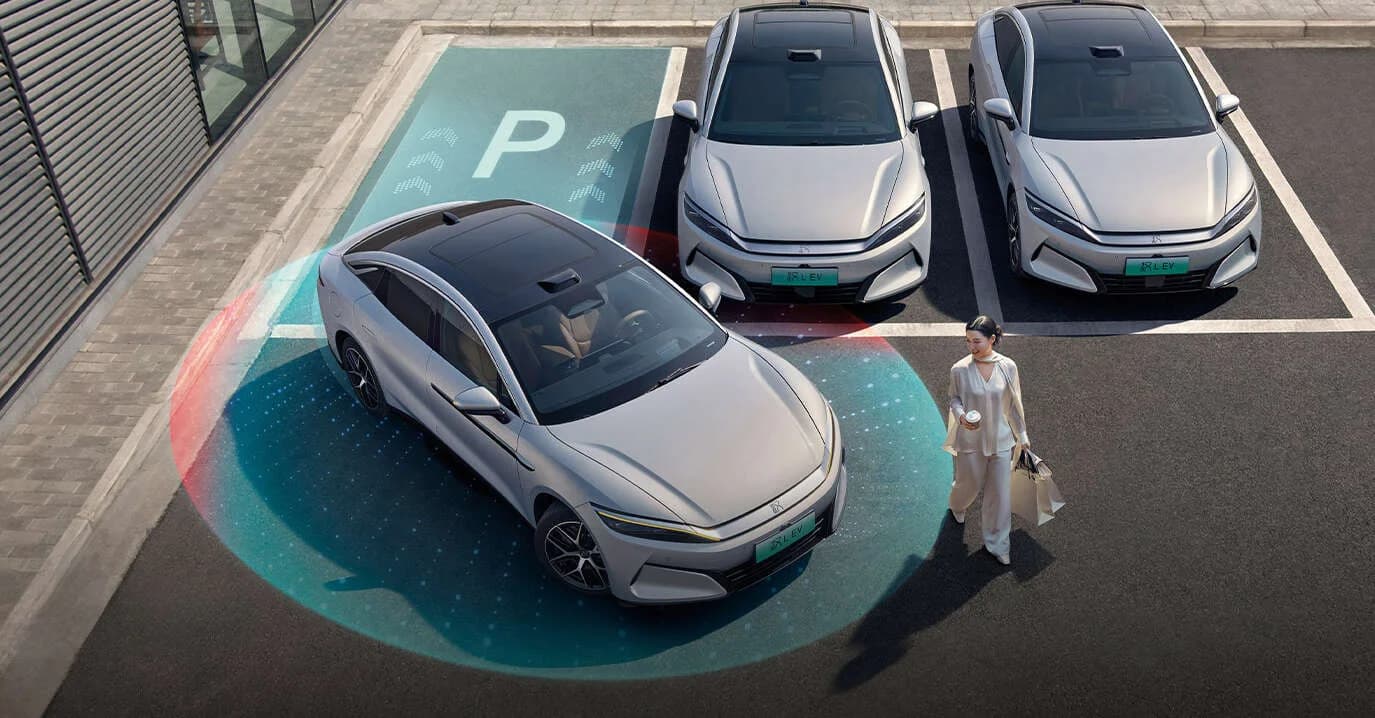
The Stress of Urban Parking: A Persistent Barrier to EV Adoption
The transition from internal combustion engine (ICE) vehicles to electric vehicles (EVs) represents the most significant shift in automotive history since the assembly line. Yet, amidst the conversations about kilowatt-hours, range anxiety, and charging infrastructure, a fundamental, daily operational challenge persists for the urban driver: the parking maneuver. For the modern consumer navigating the dense, historically constructed streets of European cities—be it the tight arrondissements of Paris, the narrow lanes of Brussels, or the congested centers of London—parallel parking remains a high-stress "moment of truth."
This anxiety is not merely psychological; it is rooted in the evolving physical dimensions of modern vehicles. To accommodate substantial battery packs within the wheelbase while maximizing cabin ergonomics—a design philosophy BYD refers to as the "e-Platform 3.0" architecture—electric vehicles often possess wider tracks and longer wheelbases than the compact ICE hatchbacks they replace. Furthermore, the pursuit of aerodynamic efficiency to maximize range often necessitates higher beltlines and tapered rear greenhouses, which can compromise direct rearward visibility. Consequently, the reliance on technological assistance has shifted from a luxury convenience to a safety-critical necessity.
Into this landscape enters Build Your Dreams (BYD), an automotive giant that has pivoted from being a battery manufacturer to a technology-first automaker. BYD recognizes that for the "classic car consumer," the parking experience is a primary touchpoint of user satisfaction. By investing heavily in the vertical integration of sensor hardware and algorithmic processing, BYD aims to democratize Level 2+ autonomous parking features, making "perfect-on-the-first-try" side parking accessible to drivers of all skill levels.
For those currently evaluating the secondary market, where value retention is closely tied to the technological relevance of the vehicle’s feature set, understanding these capabilities is paramount. Whether you are seeking the compact agility of a Dolphin or the executive presence of a Seal, the DiPilot parking technologies discussed in this report are available at significantly accessible price points on the pre-owned market. For those looking to explore these models, BYD-occasion.com offers a comprehensive selection of certified used vehicles ready for urban life.
Enter DiPilot: The Architecture of "Smart Driving"
To understand how a BYD vehicle parks itself, one must first comprehend the ecosystem that governs its motion: DiPilot. Unlike legacy manufacturers who often source disparate ADAS components from various Tier 1 suppliers, BYD’s strategy leans heavily on vertical integration. The DiPilot platform is segmented into tiers, reflecting the diverse needs of the market:
- DiPilot 100: The foundational system found in mass-market models like the Atto 3 and Dolphin. It relies primarily on a "Vision + Ultrasound" fusion approach, utilizing Surround View Cameras and ultrasonic sensors to map the immediate environment.
- DiPilot 300: A mid-tier system introduced in premium models like the BYD Seal and Denza lines, often incorporating higher processing power to handle more complex scenarios.
- DiPilot 600: The flagship tier, reserved for the Yangwang and high-end specialized models, which integrates LiDAR (Light Detection and Ranging) to provide centimeter-level accuracy even in total darkness.
This tiered approach allows BYD to scale its parking technology. The integration of these systems represents a fusion of electrification and intelligence. The precise control of electric motors allows for micro-adjustments in torque and speed during parking maneuvers that internal combustion engines simply cannot replicate. This electric precision is the hidden variable that makes BYD's auto-park features notably smooth.
2. Understanding the Hardware: How Your BYD "Sees" the Spot
A vehicle's ability to park autonomously or assist a driver in doing so is entirely dependent on its perception of the world. The BYD parking system does not "see" in the biological sense; it constructs a digital model of reality based on a stream of data inputs.
The Sensor Array: The Ultrasonic Foundation
The "workhorse" of any parking system is the ultrasonic radar. These are the small, button-sized circles visible on the front and rear bumpers of the vehicle.
- Mechanism of Action: Ultrasonic sensors operate on the principle of Time-of-Flight (ToF). The sensor emits a high-frequency sound wave which reflects back to the sensor. The system calculates the precise distance to the object based on the time interval.
- Sensor Count and Distribution: Most European and Australian delivered models feature a 4+2 or 4+4 configuration. The rear array provides a full "wall" of detection, though having fewer front sensors may create potential blind spots directly in the center of the front nose.
- Advanced Configuration: High-spec models utilize a 12-sensor array (6 Front + 6 Rear) for complete 360-degree coverage, essential for fully automated parking.
The Vision System: Cameras and Photons
While ultrasonics provide distance data, they cannot identify what an object is. This is where the camera system becomes critical. A typical BYD setup employs four primary "fisheye" cameras:
- Front Grille Camera: Located below the BYD logo.
- Rear Camera: Located above the license plate.
- Side Mirror Cameras (Left/Right): Located on the underside of the wing mirrors.
The 360° Panoramic View offers a virtual bird's-eye view of the car. One of BYD’s signature software features is Transparent Chassis Technology, which allows the driver to see parking stops, debris, or lane markings that are physically underneath the vehicle.
LiDAR vs. Vision: The High-End Divergence
As we look toward the 2025 and 2026 model years, a hardware divergence is occurring based on the DiPilot tier:
- The Vision-Only Approach (DiPilot 100): Relies on Vision + Radar. It requires contrast and may struggle in snow-covered lots or unlit garages.
- The LiDAR Advantage (DiPilot 300/600): Emits laser pulses to create a high-fidelity 3D point cloud. It works in pitch blackness and provides millimeter precision for tight garages.
3. Manual Mastery: Using BYD Parking Assist for Side Parking
Manual parking in a BYD implies an "augmented" experience where the car acts as a co-pilot providing telemetry.
Activating the Visual Aids
- Hard Button: A physical button marked with a camera icon or "PV" engages the 360° view instantly.
- Voice Command: Commands like "Open 360 view" allow for hands-free activation.
- Automatic Reverse: Shifting to 'R' triggers the system immediately.
Deciphering the Trajectory Lines
- The Blue Lines (Neutral/Static Guide): These show where the car goes if you drive straight. Use them to gauge if the spot is large enough.
- The Yellow Lines (Dynamic Trajectory): These bend in real-time as the steering wheel is turned. Adjust your steering until the Yellow loop lands inside the parking box.
- The Red Line (Proximity Limit): This represents a distance of 30-50 cm from the rear bumper. Stop when an object touches this line.
To protect diamond-cut alloy wheels, use the Side View icon to switch to raw feeds from the Side Mirror Cameras. This allows you to see the tire sidewall and the curb stone in high definition, ensuring a 5-10cm gap.
4. The "Auto-Park" Feature: A Step-by-Step Guide
The Automatic Parking Assist (APA) capability offers a hands-off solution through four distinct phases:
- Step 1: The Search Phase: Engage "Auto Park" and drive past the target space under 30 km/h. Sensors measure depth and cameras scan for lines.
- Step 2: Engagement and Selection: Once a spot is found, tap the desired slot on the screen and bring the vehicle to a stop.
- Step 3: Hands-Off Execution: Release the steering wheel. The Electric Power Steering takes control while the car manages throttle and brake.
- Step 4: Safety Interruption: The system will abort if it detects resistance on the wheel, an obstacle, or if a door is opened.
5. Model-Specific Comparison: Atto 3 vs. Seal vs. Dolphin
- BYD Dolphin: Features rear sensors and a 360° camera on higher trims. Often lacks front sensors in export versions, making it an urban specialist for manual maneuvering.
- BYD Atto 3: Well-equipped with front and rear sensors and full APA support. The "Transparent Chassis" is a standout feature for suburban use.
- BYD Seal: The technology flagship featuring DiPilot 300 or 600. It offers higher processing power, more sensors, and (in 2026 models) LiDAR for maximum precision.
6. Advanced Feature: Remote Parking (The "Cell Phone" Trick)
Remote Parking Assist (RPA) allows a driver to stand outside the vehicle and guide it into a garage via a smartphone. The phone connects via Bluetooth Low Energy for a low-latency connection.
In Europe, this feature faces regulatory hurdles due to UN Regulation No. 79, which mandates strict limits on the distance between the remote control and the vehicle. While the hardware is ready, software is often disabled in European units until certification is fully homologated.
7. Troubleshooting Common Parking Assist Issues
- Sensor Obstruction: Mud, ice, or wax can "blind" ultrasonic sensors. Solution: Gently wipe sensors with a damp microfiber cloth.
- Lighting Conditions: Low light or glare can cause vision system failure. Solution: Revert to manual parking using mirrors and the yellow trajectory lines.
- Software Glitches: If the screen freezes, perform a soft reset by holding the volume scroll wheel for 10-15 seconds. Ensure the car is updated via Over-The-Air (OTA) patches.
8. Conclusion
BYD is democratizing automotive luxury by bringing 360° 3D rendering and automated maneuvering to mass-market electric vehicles. While these tools turn the stress of urban parking into a predictable process, technology remains a tool. Drivers should "trust but verify" by using cameras while keeping eyes on the surroundings. As European regulations evolve, many dormant hardware features may soon be unlocked, further increasing the value and utility of these vehicles.
Would you like me to convert this content into a clean HTML table comparing the sensor hardware for these specific models?